.webp)
Mastering TensorFlow: The Backbone of Modern AI and Machine Learning
2.Tensorflow
Title:"Mastering TensorFlow: The Backbone of Modern AI
and Machine Learning"
Short Description:
TensorFlow is a powerful open-source platform developed by
Google for machine learning and deep learning. It provides a comprehensive
ecosystem of tools, libraries, and community resources to build and deploy AI
applications.
Introduction (Around 1500 Words):
In the rapidly evolving world of artificial intelligence
(AI) and machine learning (ML), having a robust and flexible framework is
crucial for developing and deploying sophisticated models. TensorFlow, an
open-source platform developed by Google, has emerged as a leading tool in this
domain. It offers a comprehensive ecosystem that includes tools, libraries, and
community resources designed to facilitate the creation of AI and ML
applications. TensorFlow's versatility and scalability make it suitable for a wide
range of tasks, from simple linear regressions to complex deep learning models.
This introduction will delve into what TensorFlow is, its key features, types,
workflow, and applications, providing a detailed overview of this powerful
tool.
1. About TensorFlow
TensorFlow is an open-source machine learning framework
developed by the Google Brain team. Released in 2015, it has since become one
of the most popular and widely-used platforms for building and deploying
machine learning models. TensorFlow’s design is based on computational graphs,
which allow for efficient execution of mathematical operations across different
devices, including CPUs, GPUs, and TPUs.
2. Introduction to TensorFlow (Around 1500 Words)
2.1 The Genesis of TensorFlow
TensorFlow was developed with the goal of enabling
researchers and developers to build and deploy machine learning models with
ease. It originated from DistBelief, a proprietary machine learning system used
internally at Google. Recognizing the need for a more flexible and scalable
platform, the Google Brain team created TensorFlow, which quickly gained
traction due to its open-source nature and comprehensive documentation.
2.2 How TensorFlow Works
At the heart of TensorFlow is the concept of computational
graphs. A computational graph is a series of connected nodes, where each node
represents a mathematical operation, and the edges between nodes represent the
data (tensors) flowing between these operations. This graph-based approach
allows TensorFlow to perform automatic differentiation, which is essential for
training neural networks.
TensorFlow supports various high-level APIs, such as Keras,
which simplify the process of building and training models. Additionally,
TensorFlow's lower-level API provides fine-grained control for more complex
model architectures and custom operations. TensorFlow can run on multiple
platforms, including desktops, servers, and mobile devices, thanks to its
compatibility with different hardware accelerators.
2.3 Key Features and Capabilities
Versatility: TensorFlow supports a wide range of machine
learning and deep learning algorithms, making it suitable for various
applications, from natural language processing to computer vision.
Scalability: TensorFlow can scale seamlessly from
single-device training to distributed training across multiple machines,
enabling the handling of large datasets and complex models.
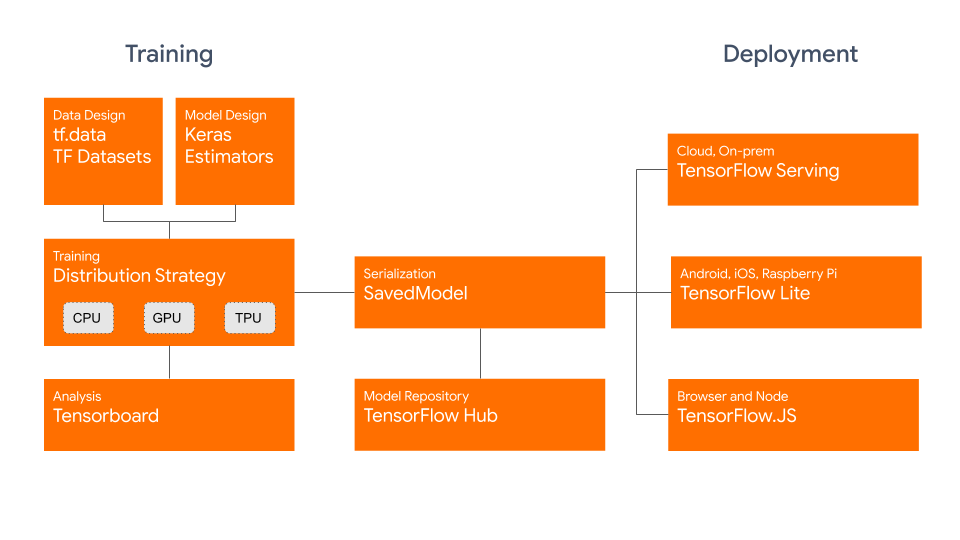
Production-Ready: TensorFlow Serving and TensorFlow Lite
provide tools for deploying models in production environments, whether on
servers or edge devices.
Community and Ecosystem: TensorFlow boasts a vibrant
community and a rich ecosystem of tools and libraries, including TensorFlow
Extended (TFX) for end-to-end ML pipelines, TensorFlow.js for running models in
the browser, and TensorFlow Hub for sharing pre-trained models.
2.4 Applications of TensorFlow
Natural Language Processing (NLP): TensorFlow is widely used
in NLP applications, such as sentiment analysis, language translation, and text
generation. Its support for recurrent neural networks (RNNs) and transformers
makes it ideal for processing sequential data.
Computer Vision: TensorFlow powers numerous computer vision
applications, including image classification, object detection, and image
segmentation. Its ability to leverage convolutional neural networks (CNNs)
allows for efficient processing of visual data.
Healthcare: TensorFlow is employed in healthcare for tasks
like medical image analysis, disease prediction, and personalized treatment
planning. Its ability to handle large-scale data and perform complex
computations makes it valuable in this domain.
Finance: Financial institutions use TensorFlow for fraud
detection, algorithmic trading, and risk management. TensorFlow's powerful
analytical capabilities help in making data-driven decisions.
Robotics: TensorFlow is used in robotics for tasks such as
autonomous navigation, object manipulation, and human-robot interaction. Its
support for reinforcement learning enables the training of intelligent robotic
systems.
3. Types of TensorFlow
TensorFlow offers various versions and specialized tools
tailored to different use cases:
TensorFlow 1.x: The original version of TensorFlow, which
introduced the concept of static computational graphs. While still in use, it
has largely been succeeded by TensorFlow 2.x.
TensorFlow 2.x: The latest version of TensorFlow, which
emphasizes ease of use and flexibility. TensorFlow 2.x adopts eager execution
by default, allowing for dynamic computation graphs and more intuitive
debugging.
TensorFlow Lite: A lightweight version of TensorFlow
designed for mobile and embedded devices. TensorFlow Lite optimizes models for
performance and resource efficiency, enabling machine learning on the edge.
TensorFlow.js: A JavaScript library for training and
deploying machine learning models in the browser and on Node.js. TensorFlow.js
makes it possible to bring ML to web applications with ease.
TensorFlow Extended (TFX): An end-to-end platform for
deploying production ML pipelines. TFX includes components for data validation,
model training, serving, and monitoring.
4. Workflow of TensorFlow (Step by Step)
To effectively use TensorFlow, follow these steps:
Set Up the Environment: Install TensorFlow and other
necessary libraries using package managers like pip or conda. Ensure you have
the appropriate hardware and software setup for your specific use case.
Prepare the Data: Collect and preprocess the data. This
involves cleaning, normalizing, and splitting the data into training,
validation, and test sets.
Define the Model: Choose an appropriate model architecture
based on the problem at hand. Use TensorFlow’s high-level APIs like Keras to
define the model layers and configurations.
Compile the Model: Configure the model with an optimizer,
loss function, and metrics for evaluation. This step prepares the model for
training.
Train the Model: Feed the training data into the model and
adjust the parameters to minimize the loss function. Monitor the training
process using callbacks and TensorBoard for visualization.
Evaluate the Model: Assess the model’s performance on the
validation and test sets. Fine-tune the model if necessary to improve accuracy
and generalization.
Deploy the Model: Use TensorFlow Serving, TensorFlow Lite,
or TensorFlow.js to deploy the trained model in production environments,
ensuring it can handle real-world data and applications.
Monitor and Maintain: Continuously monitor the model’s
performance and update it as needed to adapt to new data or changing
requirements.
5. Conclusion