Hospital Database Management System: Streamlining Healthcare Operations with Smart Data Management
Introduction
Modern hospitals handle a huge amount of information every day. Patient details, medical histories, appointments, doctor schedules, prescriptions, laboratory reports, billing records, pharmacy inventory, and staff information all need to be stored and accessed efficiently.
Managing this information manually can lead to paperwork, duplicate records, data-entry errors, and delays. A Hospital Database Management System (HDMS) provides a centralized digital solution that allows healthcare organizations to securely store, organize, update, and retrieve important information.
What is Hospital Database Management?
Hospital Database Management is the process of storing and managing healthcare-related information using a structured digital database.
A hospital database can connect multiple departments and allow authorized users to access relevant information from a single system.
For example, when a patient visits a hospital, their information can be recorded once and then used by different departments such as:
- Reception
- Doctors
- Nursing
- Laboratory
- Pharmacy
- Billing
- Radiology
- Inventory
- Administration
This creates a connected healthcare environment where information can move efficiently between departments.
Key Modules of a Hospital Database Management System
1. Patient Management
The patient management module stores important patient information such as:
- Patient Name
- Patient ID
- Contact Details
- Address
- Date of Birth
- Medical History
- Allergies
- Previous Visits
- Diagnosis
- Treatment Records
Doctors and authorized hospital staff can quickly access patient information whenever required.
2. Doctor Management
The system can maintain complete information about doctors, including:
- Doctor Name
- Department
- Specialization
- Contact Information
- Availability
- Consultation Schedule
- Assigned Patients
This makes it easier for hospital administrators to manage doctor schedules and workloads.
3. Appointment Management
An appointment management module helps hospitals organize patient appointments efficiently.
It can manage:
- Appointment Date
- Appointment Time
- Patient Details
- Doctor Details
- Department
- Appointment Status
- Follow-up Appointments
Patients can be assigned to available time slots, helping reduce scheduling conflicts.
4. Medical Records Management
Electronic medical records are one of the most important components of a hospital database.
The system can store:
- Patient history
- Diagnosis
- Prescriptions
- Treatment details
- Laboratory reports
- Medical notes
- Previous consultations
Having medical information in one place allows authorized doctors to understand a patient's history more quickly.
5. Laboratory Management
The laboratory module can manage test requests and reports.
It may include:
- Test Name
- Patient ID
- Doctor Name
- Sample Information
- Test Results
- Report Date
- Laboratory Technician
Digital laboratory records can reduce paperwork and make reports easier to retrieve.
6. Pharmacy Management
Hospital pharmacies need accurate inventory and prescription management.
A database can track:
- Medicine Name
- Medicine Code
- Batch Number
- Expiry Date
- Available Quantity
- Supplier
- Purchase Price
- Selling Price
The system can also help administrators identify medicines that are running low or approaching their expiry date.
7. Billing and Payment Management
The billing module manages financial transactions related to patients.
It can include:
- Consultation Charges
- Laboratory Charges
- Pharmacy Charges
- Room Charges
- Treatment Charges
- Discount
- Tax
- Payment Status
- Invoice Details
A centralized billing system helps reduce calculation errors and improves financial record management.
8. Bed and Room Management
For hospitals with inpatient facilities, bed management is essential.
The database can show:
- Total Beds
- Available Beds
- Occupied Beds
- Reserved Beds
- Ward Information
- Room Number
- Patient Assigned to Bed
- Admission Date
- Discharge Date
This allows hospital administrators to quickly understand bed availability.
Benefits of Hospital Database Management
Improved Data Accuracy
A centralized database reduces duplicate data entry and helps maintain consistent patient and hospital records.
Faster Access to Information
Authorized staff can quickly search and retrieve patient, appointment, billing, or medical information.
Reduced Paperwork
Digital records reduce dependence on physical files and manual documentation.
Better Patient Care
Doctors can access relevant medical information faster, helping them make informed decisions.
Improved Department Coordination
Different departments can work with connected information instead of maintaining isolated records.
Better Security
User authentication and role-based access can help ensure that sensitive healthcare information is available only to authorized personnel.
Efficient Reporting
Hospital administrators can generate reports related to patients, appointments, revenue, inventory, doctors, beds, and other operations.
Hospital Database Architecture
A hospital database generally contains multiple interconnected tables.
For example:
Patient Table
PatientID | PatientName | Mobile | Address | DateOfBirth | Gender
Doctor Table
DoctorID | DoctorName | Department | Specialization | Contact
Appointment Table
AppointmentID | PatientID | DoctorID | AppointmentDate | Status
Medical Records Table
RecordID | PatientID | DoctorID | Diagnosis | Treatment | Date
Billing Table
BillID | PatientID | TotalAmount | PaymentStatus | BillDate
Medicine Table
MedicineID | MedicineName | Quantity | BatchNo | ExpiryDate
Relationships between these tables allow the system to connect patients with doctors, appointments, medical records, prescriptions, billing, and other hospital activities.
Security in Hospital Database Management
Healthcare information is sensitive, so database security should be a major priority.
A hospital management system should consider:
- Secure login authentication
- Role-based access control
- Strong passwords
- Data encryption
- Regular database backups
- Audit logs
- Secure server configuration
- Controlled access to medical records
- Regular security updates
For example, a receptionist may need access to patient registration and appointments, while a doctor may require access to medical records and prescriptions. Administrators may need access to reports and financial information.
Role of Database Technology in Modern Hospitals
Modern database technologies can help hospitals move from traditional paper-based processes toward centralized digital operations.
A web-based hospital database management system can provide access through computers, tablets, and smartphones, depending on the hospital's requirements and security architecture.
Technologies such as PHP, MySQL, HTML, CSS, JavaScript, Bootstrap, and REST APIs can be used to build customized hospital management applications.
More advanced systems can also integrate analytics, automated notifications, dashboards, and other digital healthcare tools.
Hospital Dashboard and Reporting
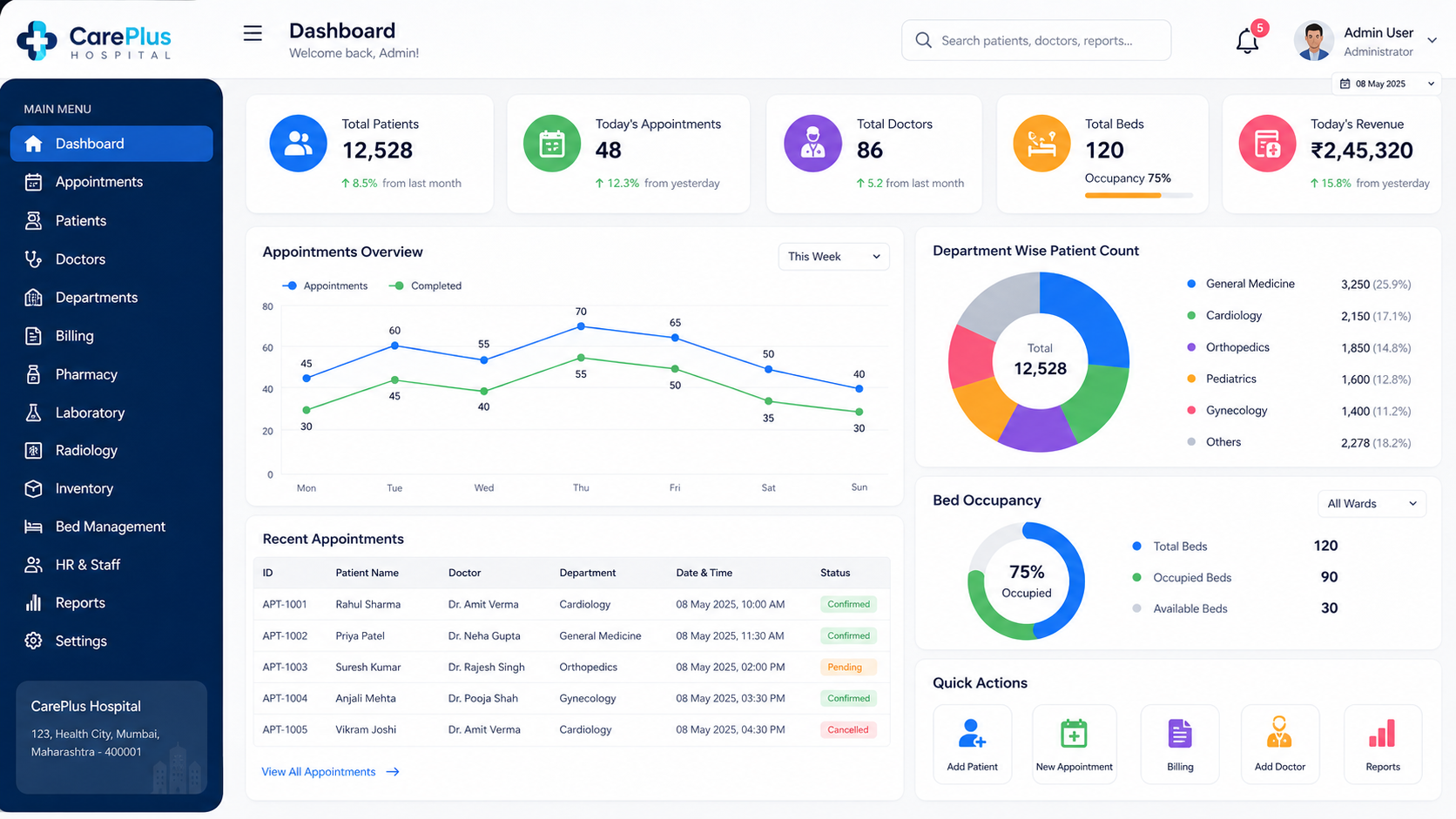
A hospital administrator dashboard can provide a quick overview of hospital operations.
Important dashboard statistics may include:
- Total Patients
- Today's Appointments
- Total Doctors
- Available Beds
- Occupied Beds
- Today's Revenue
- Pending Appointments
- Laboratory Tests
- Pharmacy Stock
- Recent Patient Records
Visual charts and reports can help administrators understand hospital performance and make better operational decisions.
Future of Hospital Database Management
The future of hospital database management is moving toward smarter and more connected healthcare systems.
Emerging technologies can support:
- Cloud-based healthcare databases
- Mobile healthcare applications
- Real-time hospital dashboards
- AI-assisted data analysis
- Automated appointment notifications
- Digital prescriptions
- Online patient portals
- Integrated laboratory and pharmacy systems
- Advanced healthcare analytics
The goal is to create a connected system where authorized healthcare professionals can access accurate information securely and efficiently.
Conclusion
A Hospital Database Management System is an important component of modern healthcare infrastructure. It brings patient records, doctors, appointments, medical reports, billing, pharmacy, laboratory, inventory, and hospital administration together in a centralized system.
By reducing paperwork, improving data accuracy, providing faster access to information, and supporting secure digital operations, hospital database management can help healthcare organizations improve both operational efficiency and patient experience.
For hospitals planning to modernize their operations, a well-designed database management system can provide a strong foundation for building a secure, scalable, and efficient digital healthcare environment.