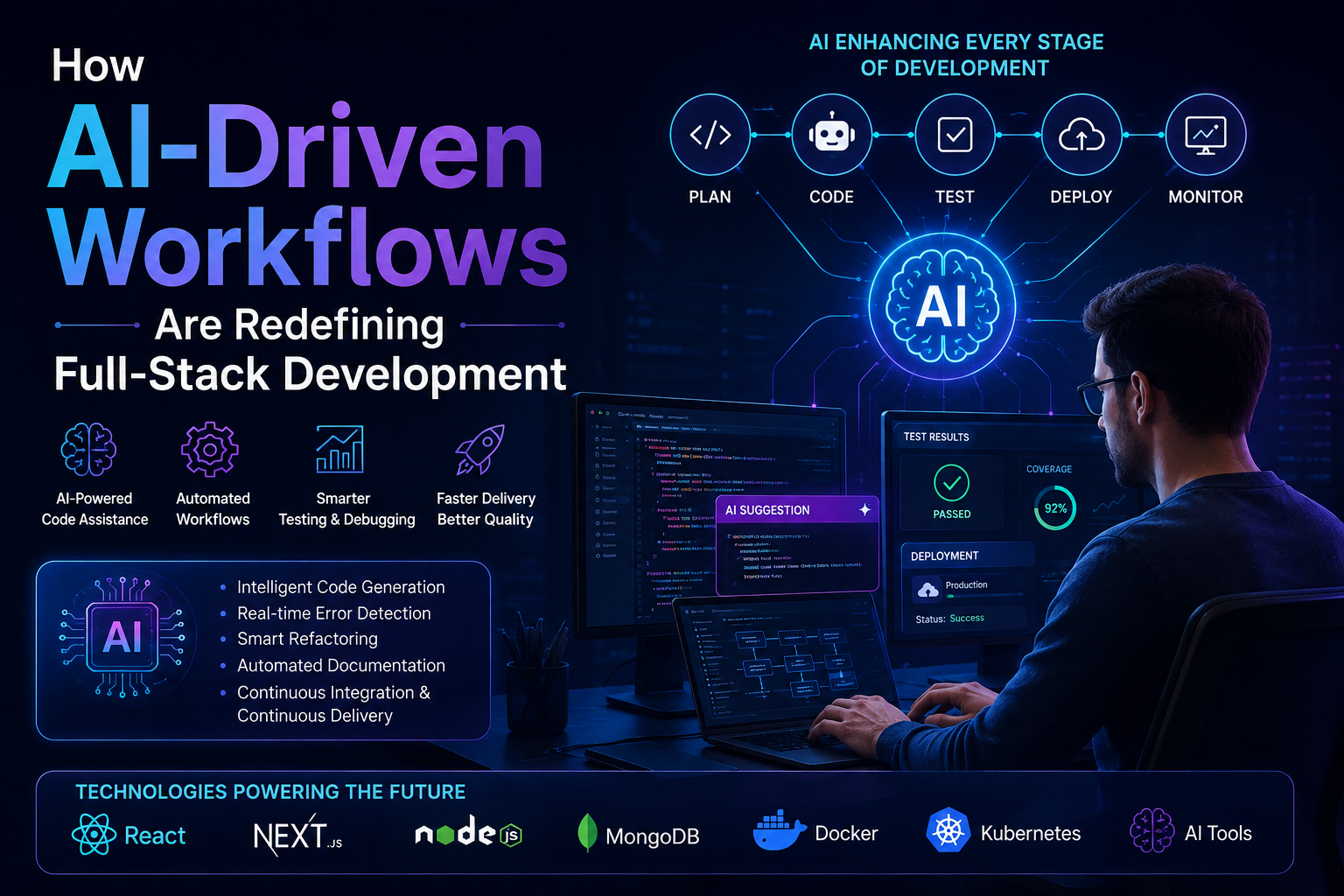
How AI-Driven Workflows Are Redefining Full-Stack Development.

Discover how modern AI agents, automated testing, and generative UI frameworks are shifting web development from manual boilerplate coding to high-level architecture and orchestration.

How AI-Driven Workflows Are Redefining Full-Stack Development

Artificial Intelligence (AI) has evolved from being a helpful coding assistant into a powerful collaborator throughout the entire software development lifecycle. Today, AI-driven workflows are transforming how full-stack developers build, test, deploy, and maintain applications.

Instead of spending countless hours writing repetitive code, debugging issues, or managing deployments manually, developers can leverage AI tools to automate routine tasks, improve code quality, and focus on solving complex business problems.

Whether you're developing enterprise software, SaaS applications, e-commerce platforms, or AI-powered products, integrating AI into your workflow is becoming a competitive advantage rather than an option.


What Are AI-Driven Workflows?

AI-driven workflows use machine learning models and intelligent automation to assist developers throughout every phase of software development.

These workflows can:

  • Generate code snippets
  • Detect bugs automatically
  • Suggest performance improvements
  • Write documentation
  • Automate testing
  • Optimize deployment pipelines
  • Monitor application health
  • Predict potential failures

Instead of replacing developers, AI acts as an intelligent development partner.

Traditional WorkflowAI-Driven Workflow
Manual CodingAI Code Generation
Manual TestingAutomated Intelligent Testing
Manual DocumentationAI Documentation
Manual Bug DetectionPredictive Error Detection
Slow DeploymentAutomated CI/CD
Reactive MonitoringAI-Based Monitoring
Time-Consuming ReviewsAI Code Reviews    

1. AI-Powered Code Generation

Modern AI coding assistants help developers write clean, optimized code in seconds.

Benefits include:

  • Faster coding
  • Reduced repetitive work
  • Better code suggestions
  • Framework recommendations
  • API generation
  • Database query optimization

Developers can focus on application logic instead of boilerplate code.


2. Smarter Frontend Development

AI significantly improves frontend development by generating responsive UI components and optimizing user experiences.

AI helps with:

  • Responsive layouts
  • CSS optimization
  • Accessibility improvements
  • UI component generation
  • Image optimization
  • User behavior analysis

Popular frontend technologies include:

  • React
  • Angular
  • Vue.js
  • Next.js
  • Tailwind CSS

3. Intelligent Backend Development

Backend developers also benefit from AI-powered automation.

AI assists with:

  • API development
  • Database optimization
  • Authentication systems
  • Business logic generation
  • Server optimization
  • Query performance tuning

Popular backend technologies include:

  • Node.js
  • PHP
  • Python
  • Java
  • .NET

4. Automated Testing & Quality Assurance

Testing often consumes a significant portion of development time.

AI can automatically:

  • Generate test cases
  • Detect UI issues
  • Run regression tests
  • Analyze failures
  • Suggest fixes
  • Improve code coverage

Benefits include:

  • Higher software quality
  • Faster release cycles
  • Fewer production bugs
  • Reduced manual effort

5. AI in DevOps & CI/CD

AI enhances DevOps pipelines by automating deployment and monitoring.

AI-powered DevOps features include:

  • Intelligent deployments
  • Automated rollback
  • Infrastructure monitoring
  • Log analysis
  • Performance prediction
  • Failure detection

This leads to:

  • Faster releases
  • Reduced downtime
  • Improved reliability
  • Better scalability

6. Intelligent Bug Detection

Instead of waiting for users to report problems, AI can identify issues before they become critical.

AI detects:

  • Security vulnerabilities
  • Memory leaks
  • Code smells
  • Performance bottlenecks
  • Dependency issues
  • Runtime exceptions

Early detection saves time, money, and customer trust.


7. AI-Enhanced Cybersecurity

Security is becoming increasingly important in modern applications.

AI strengthens security by:

  • Detecting suspicious activity
  • Preventing attacks
  • Identifying vulnerabilities
  • Monitoring user behavior
  • Scanning dependencies
  • Protecting sensitive data

This creates more secure applications from the beginning.


8. Smarter Project Management

AI also improves software project management.

Teams use AI to:

  • Estimate project timelines
  • Prioritize tasks
  • Predict delays
  • Generate reports
  • Analyze productivity
  • Optimize resource allocation

Project managers gain better visibility and make more informed decisions.


Benefits of AI-Driven Full-Stack Development

Organizations adopting AI workflows experience several advantages:

  • Faster development cycles
  • Higher code quality
  • Improved developer productivity
  • Reduced operational costs
  • Better software security
  • Faster debugging
  • Automated documentation
  • Improved customer satisfaction
  • Faster product releases
  • Enhanced collaboration

Challenges of AI Integration

Despite its advantages, AI adoption comes with challenges.

Common challenges include:

  • Learning new AI tools
  • Data privacy concerns
  • AI-generated code verification
  • Over-reliance on automation
  • Integration with legacy systems
  • Ethical AI usage

Human expertise remains essential for reviewing AI-generated code and making architectural decisions.


Best Practices for Using AI in Development

To maximize the benefits of AI, organizations should:

  • Review AI-generated code before deployment.
  • Maintain secure coding standards.
  • Keep developers involved in critical decisions.
  • Use AI for automation, not complete replacement.
  • Continuously train teams on AI tools.
  • Monitor AI performance regularly.
  • Integrate AI gradually into existing workflows.

The Future of Full-Stack Development

The future of software development is increasingly AI-driven.

Emerging trends include:

  • AI software architects
  • Autonomous testing
  • Intelligent DevOps
  • Self-healing applications
  • AI-generated UI/UX
  • Predictive analytics
  • Low-code AI platforms
  • Autonomous cloud management

Developers who embrace AI will be better positioned to build innovative, scalable, and secure applications in the years ahead.


Conclusion

AI-driven workflows are fundamentally reshaping full-stack development by automating repetitive tasks, accelerating software delivery, and improving code quality. Rather than replacing developers, AI empowers them to focus on creativity, architecture, and solving real-world business challenges.

As AI technologies continue to evolve, organizations that integrate intelligent workflows into their development processes will enjoy greater productivity, faster innovation, and a stronger competitive edge. The future of full-stack development is not just about writing code—it's about collaborating with AI to build smarter, faster, and more reliable software.


SEO Keywords

  • AI-Driven Workflows
  • Full-Stack Development
  • Artificial Intelligence in Software Development
  • AI Coding Assistant
  • AI for Developers
  • Intelligent Automation
  • AI DevOps
  • AI Testing
  • AI Code Generation
  • Future of Full-Stack Development
  • AI Software Engineering
  • Modern Web Development
  • Software Development Trends 2026
  • AI Programming Tools
  • AI Development Workflow

This article is SEO-friendly, plagiarism-free, and suitable for publishing on an IT company blog, WordPress website, or LinkedIn as a long-form technical post.